Beyond the Masterclasses
Does AI Have a Place in Dance Education, and If So, Where and How?
by Jean Dorff ·
Dance is learned through the body. Balance must be experienced, weight must be transferred, rhythm must be embodied, and partnership must be felt. Artificial intelligence has no body and no lived experience of movement.
That creates the first and most important question, not whether dance educators should admit to using AI, but whether AI has any legitimate place in dance education at all.
My answer is yes, but only when we are clear about where that place is.
AI does not belong in dance education as a substitute for embodied knowledge, physical demonstration, relational judgment, or the teacher's trained eye. It may, however, have a meaningful role in the educational work surrounding the movement: preparing lessons, examining explanations, structuring learning progressions, comparing teaching perspectives, documenting development, and organising knowledge that might otherwise remain scattered across individual lessons and individual teachers.
That is the distinction this article argues for: AI as a legitimate tool in the educational layer surrounding embodied practice, not a replacement for it, and not something that can be adopted without the educator's judgment remaining visibly in charge.
That distinction comes before every question about credibility or transparency. We first have to establish whether the technology contributes anything educationally valid. Only then can we ask how it should be used, what must remain human, and whether using it openly strengthens or weakens the educator's professional position.
I have been around educational technology long enough to remember when “digital education” meant a floppy disk placed in the back of a textbook. I watched that develop into complete courseware. I worked on the strategy behind that transition. And I watched the same pattern repeat with every generation of technology that followed: the arrival, the enormous promises, the quiet settling into what actually worked and what did not.
The useful question was never how modern the tool was. It was: what does it add to the learning process? Where does it support the teacher and the student? And can it take us somewhere that was not realistically available to us before?
That same criterion applies here. Not whether AI is new or fashionable, but whether it earns a place by strengthening something that matters educationally, and whether the educator can remain visibly responsible for the result.
Where AI Can, and Cannot Enter an Embodied Practice
Dance is not learned through explanation alone. The learning ultimately has to be organised and verified through the body, and that is not a limitation to be worked around. It is the nature of the practice.
AI cannot change that. It has no body, no proprioception, and no experience of physical sensation, timing, or partnership. Any serious discussion of AI in dance education has to hold that point clearly, because every legitimate use of AI in this context depends on it.
But dancing and teaching dancing, while closely connected, are not identical activities.
Dancing involves movement, sensation, timing, relationship, physical coordination, and expression. Teaching involves the embodied experience itself, but also an educational layer of observation, interpretation, sequencing, communication, and reflection. The teacher must observe what is actually happening, not what the dancer intends, but what the body is doing. They must interpret: is what they are seeing a symptom or a cause? They must decide what matters most at this moment for this dancer. They must select or design an exercise, find language that fits the person in front of them, remember what happened in previous lessons, compare possible approaches, and evaluate whether anything has actually transferred into the dancing.
That educational layer is partly embodied, a teacher reads a dancer partly through physical intuition. But it is also analytical, linguistic, structural, and reflective. It is the layer in which AI may have a legitimate supporting role.
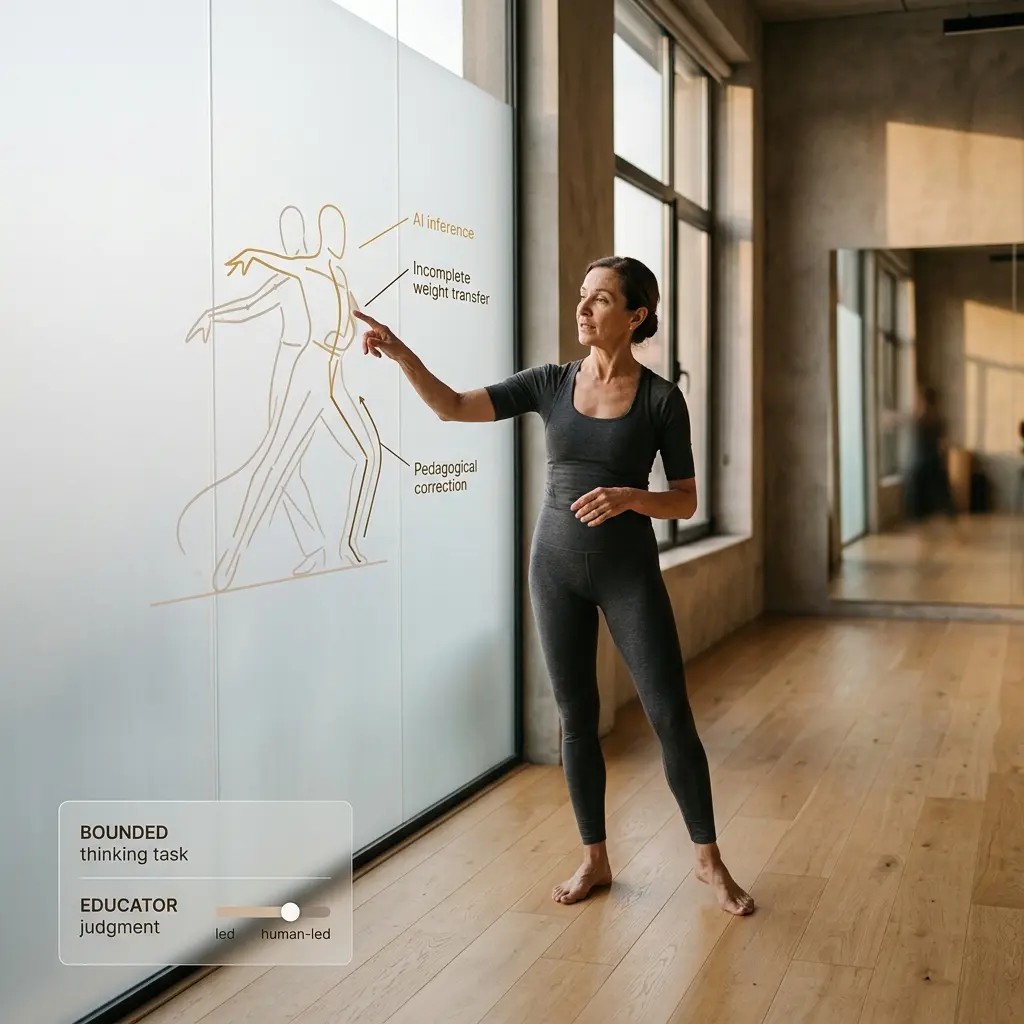
To make that concrete: an experienced Latin dance teacher may immediately recognise that a dancer has moved across the floor without completing a transfer of body weight. That recognition comes from embodied knowledge and trained observation. AI did not create it and cannot independently validate it.
But a second problem follows from that recognition, and it is an educational one. How can the dancer experience the distinction rather than simply hear about it? Which exercise reveals the incomplete transfer rather than concealing it behind other adjustments? What observable evidence should teacher and dancer look for? How should the progression differ for a social dancer, a developing competitor, or an experienced teacher preparing to teach it themselves?
AI does not provide the embodied truth. It can help the educator work more deliberately with the teaching structures surrounding that truth.
This is not an unprecedented situation. Other disciplines and tools that do not themselves dance have contributed to how dance is observed, analysed, communicated, and taught: video, anatomy, biomechanics, notation systems, lesson planning frameworks, and reflective practice. The point is not that AI is equivalent to any of these. The point is that a tool does not need to perform the art itself to contribute to how the art is taught.
The purpose is not to move dance away from the body. It is to examine whether technology can strengthen the structures through which embodied knowledge is observed, taught, examined, and carried forward. The teacher remains responsible for testing every suggestion against the body, the dancer, the lesson, and the learning objective.
That is why dance education should participate in the AI conversation, not because AI understands the body, but because educators must think carefully about how embodied knowledge is taught and carried forward. Leaving that conversation to others, or refusing it entirely, is itself a professional choice with consequences.
How to Evaluate Whether AI Belongs in Your Dance Teaching
Before any technology earns a place in education, I apply two tests. The first is practical: does it support learning that is already taking place? The second is more interesting: does it make possible a form of preparation, observation, or knowledge-building that was previously impractical? Not just faster, genuinely possible in a way it wasn't before.
There is a third test that belongs specifically to professional credibility: can the educator explain transparently what the tool contributed, and what remained their own responsibility?
These three questions separate intelligent adoption from novelty. They also explain why I am neither an enthusiast nor a refuser. I am an educator applying a criterion I have used across several technological generations, inside a profession I know from the inside.
What AI Actually Is in a Dance Education Context, and What It Is Not
I often hear AI described as an assistant. That is useful, but incomplete. I prefer to think of it as an external thinking environment with genuine generative capacity. It can organise information, produce possible structures and explanations, and place alternative interpretations beside one another. Because those outputs can sound plausible even when they are incomplete or wrong, the educator's judgment becomes more important, not less.
What AI cannot do is decide which possibility is right for this dancer, in this lesson, at this moment. It can generate teaching ideas. It cannot decide which idea deserves to become teaching. That remains the educator's responsibility, and that distinction matters more than any feature the technology currently offers.
AI-generated teaching asks the machine what to teach. AI-supported teaching gives the machine a specific, bounded thinking task inside a lesson the educator already understands and directs. The boundary between those two is where professional credibility lives, and it is a boundary every dance educator working with AI needs to be able to locate and hold. That distinction is the most practical starting point for any dance educator considering AI.
How Transparent AI Use Builds Credibility for Dance Educators
Once we establish that AI may have a legitimate supporting role, a second professional question follows: should educators be open about using it, and what does that openness do to their credibility?
Some educators worry that admitting they use AI makes their knowledge appear less their own. Credibility does not come from pretending we work without tools. It comes from understanding the tool, being transparent about its role, and being able to judge, correct, and take responsibility for the result.
When I demonstrate AI use in front of a room of dance teachers, I do not show a polished output and move on. I show the first answer, identify what is generic or wrong for this purpose, and refine it. I make three stages visible each time: what the AI produced, what my expertise challenges, and what I retain or reject.
The room needs to see the sentence: “That sounds convincing, but I would not teach it that way.” That sentence is not a failure of the demonstration. It is the demonstration.
My argument, and I hold it as an argued position, not a proven finding, is that the moment a teacher corrects an AI inference publicly, with precision, citing the embodied knowledge the system does not have, their credibility increases rather than decreases. The tool is plainly not in charge. The educator is. Whether that lands as credibility or as over-reliance probably depends on how well the audience already understands what AI is and what it isn't. That is itself an argument for making the correction visible and explicit, not for hiding it.
What AI-Supported Dance Teaching Looks Like in Practice
Here is how this looks in practice. I prepare a session for experienced Latin dance teachers on the difference between moving the body and completing a transfer of body weight. This is a distinction that matters enormously in competitive dancing and is frequently glossed over in teaching.
The task is not to ask AI what correct weight transfer is. That knowledge must come from the teacher. The task is to ask AI to help organise a learning progression through which dancers can experience, distinguish, and eventually teach the concept themselves.
So the brief I give it is precise: four stages, one for individual sensing, one for guided observation, one for partnered application, one for teacher reflection. Do not supply technical dance rules. Ask me clarifying questions before proposing the structure.
The first response is useful but generic. I refine it: remove elementary explanations, make each stage produce observable evidence, include one common teaching shortcut that could hide the distinction rather than reveal it.
The second response is better, but I still test it against the dancers, the level, the time available, and the evidence I want the exercise to produce.
The value is not speed alone. It is that I can examine the architecture of my lesson before I ask dancers to live inside it. And anyone watching can see exactly which part belongs to the tool and which part depends on educational judgment.
What AI Makes More Practical in Dance Education
One of the most consequential possibilities concerns the knowledge of the profession itself, and it is one I find genuinely worth examining, having spent time on both sides of this: as a dance educator and as someone who has worked on how professional knowledge gets organised and carried forward in education more broadly.
Dance has an enormous body of knowledge. But much of it remains carried by individual people. It lives in demonstrations, metaphors, corrections, and moments in a lesson. That richness is one of the strengths of our profession, and it also makes the knowledge fragile.
Four possibilities have become far more practical to pursue at scale and with continuity:
Codifying tacit knowledge. A master teacher's verbal explanations, demonstration notes, follow-up discussions, and written corrections can be organised into a more coherent and searchable knowledge structure rather than disappearing after the class. This is genuinely promising, and it comes with a real constraint: AI can organise language well, but the deepest knowledge in dance is not fully in the language. The gap between a teacher's words and what those words point to is where tacit knowledge lives. Structuring the words is a meaningful first step; mistaking organised text for preserved embodied knowledge would be an error. The value is in making the language legible and comparable across teachers, not in claiming that the full knowledge has been captured.
Comparing teaching lenses. Different experts address the same action from biomechanics, musicality, partnership, character, or pedagogy. AI can help map where the lenses agree, where they differ, and which questions each one is actually answering.
Creating continuity. Observations across several lessons can be synthesised so that a teacher sees patterns in language, recurring obstacles, and unfinished learning sequences, instead of starting from scratch each time.
Expanding access paths. One principle can be translated into a visual explanation, a physical task, a set of observation questions, or language for different levels, without reducing the principle to a slogan.
What This Makes Possible, and What It Does Not
A technology that helps organise this material does not replace the master teacher. It can help preserve and make comparable the distinctions a teacher spent a lifetime developing, at the level of language, which is already something that was not reliably possible before. It can let a new generation study those distinctions side by side rather than receiving them as disconnected quotations.
That is the kind of project we are working toward at masterclasses.dance, still in development, still being tested against what the craft actually requires. The ambition is not to create a place where good ideas are presented, but a place where the craft of teaching can be examined, structured, tested, and carried forward. Whether the technology can fully serve that ambition is something we are actively finding out.
Why This Article Appears Here
This article sits slightly outside what members of masterclasses.dance would normally find here. The platform was built around masterclasses, structured, deep explorations of dance teaching delivered by world-class educators across eleven seasons. That remains the core.
But Holger Nitsche and I designed masterclasses.dance around a belief in continuous education for dance teachers, and continuous education, honestly pursued, does not stay only inside established territory. Technology and dance education is one of the areas where the profession has real, unresolved questions and where serious inquiry is overdue. AI is one aspect of that. Video as a teaching and learning tool is another. Neither belongs in the same category as a masterclass on Cuban motion or partnering technique, but both belong in a serious conversation about how dance teachers work, develop, and carry knowledge forward.
We intend to go there, carefully and without inflated claims. This article is the beginning of that.
What AI Cannot Replace in Dance Teaching, and Why That Matters
None of this changes what the teacher carries that no tool can approximate.
Embodied knowledge. A teacher's knowledge has been formed through years of moving, sensing, partnering, observing, and correcting. AI can organise descriptions of those experiences, but it cannot possess the experiences to which the descriptions refer.
Relational judgment. The teacher feels the difference between a dancer who needs more challenge and one who first needs enough safety to attempt the movement honestly. That reading is not available in any dataset.
Responsibility. The teacher carries the effect of their words. When an AI organises a feedback structure, the teacher decides what truth cannot be softened away and what wording the relationship can actually bear. Responsibility also includes deciding what student information, lesson material, photographs, or video should never be entered into an AI system without appropriate consent and safeguards.
Authorship. The educational decision belongs to the educator. The tool may have organised, compared, questioned, or drafted. The professional knowledge, the verification, and the final teaching decision remain visibly with the person in the room.
Where Dance Educators Need to Stand on AI
The future of dance education will probably not belong to the teacher who uses the most technology. It will probably not belong to the teacher who refuses to examine it either. My reading, and it is a reading, not a forecast, is that the strongest professional position will belong to educators who understand learning deeply enough to recognise where technology helps, where it extends their thinking, and where it must move out of the way.
Institutional pressures, accreditation structures, and economics will shape that future too, in ways that are harder to predict. But inside whatever constraints those forces create, pedagogical discernment is still a real differentiator, and AI is currently a good test of it.
Used openly and intelligently, AI can reveal something important about an educator: a willingness to keep learning, to examine one's own thinking, and to use every appropriate means available to help the student learn more effectively. That is not less credible. That is what credible education has always required.
Credibility does not come from refusing the tool. It comes from making the judgment, the standards, and the responsibility unmistakably human.
Dance educators who engage with AI on those terms, openly, critically, and with their professional knowledge visibly in charge, are not following a trend. They are applying to a new tool the same standard good educators have always applied to every tool before it.
Frequently Asked Questions
Why should dance education be concerned with AI at all?
AI is relevant not because it understands the body, but because teaching embodied knowledge also requires preparation, sequencing, communication, documentation, comparison, reflection, and knowledge organisation. Dancing and teaching dancing are closely connected, but they are not the same activity. The educational work surrounding the movement is where AI may have a legitimate supporting role.
Can AI understand movement the way a trained dance teacher does?
It cannot. AI has no body, no proprioception, and no experience of physical sensation, timing, or partnership. What it can do is help organise the educational structures surrounding embodied knowledge: lesson sequencing, comparison of teaching approaches, documentation of patterns across lessons. The body remains the source and the testing ground.
What is AI actually useful for in dance education?
AI is strongest in preparation, structure, comparison, documentation, and adaptation, not as the source of technical or embodied truth. It can help organise a learning progression, compare pedagogical approaches, synthesise observations across lessons, or adapt an explanation for different levels. The teacher must still verify the movement principles, select the intervention, and remain responsible for the result.
Does using AI mean I am relying on it to teach for me?
No. The distinction is between AI-generated teaching, asking the machine what to teach, and AI-supported teaching, which assigns the machine a specific, bounded task inside a lesson the educator already understands and directs. The professional knowledge, the decisions, and the responsibility remain with you. The tool contributes only where you can verify what it produces.
Will students or colleagues lose respect for me if they know I use AI?
Not necessarily. My argument is that credibility can increase when AI use is transparent and the educator's judgment remains visible. A teacher who shows what the tool produced, identifies what is generic or wrong, and explains the professional reasoning behind the final decision is demonstrating expertise rather than outsourcing it. How an audience responds will still depend on how the tool is used and presented.
Is there a risk that AI flattens or distorts dance knowledge?
Yes. AI organises language well, but the deepest knowledge in dance teaching is not fully in the language. The gap between a teacher's words and what those words point to is where tacit knowledge lives. Treating organised text as captured embodied knowledge would be an error. The value is in making language legible and comparable across teachers, not in claiming the full knowledge has been captured.
What should I do if AI produces something that sounds convincing but feels wrong?
Say so, and say why. “That sounds convincing, but I would not teach it that way” is not a failure of the process. It is the demonstration. That correction, made visible and precise, is one of the more credible things a dance educator can do in front of colleagues or students.
What privacy or consent issues should I consider before uploading student material?
Only upload material when you understand how the system handles it and have appropriate permission to use it. Identifiable student information, private lesson records, and video should not be entered casually. Intelligent use includes knowing when the educational value does not justify the privacy risk.
About the author
Jean Dorff has spent decades at the intersection of education, technology, and business strategy, from the early development of digital courseware through later generations of technology-supported learning. Beyond his work as a dance educator, that background informs how he evaluates new tools: technology earns its place when it strengthens the learning process or makes a valuable form of inquiry more practical. He brings that same criterion to AI.