
Season 12 · Invisible Layer · Featuring Holger Nitsche
The Invisible Layer That Makes Top Couples Look Different
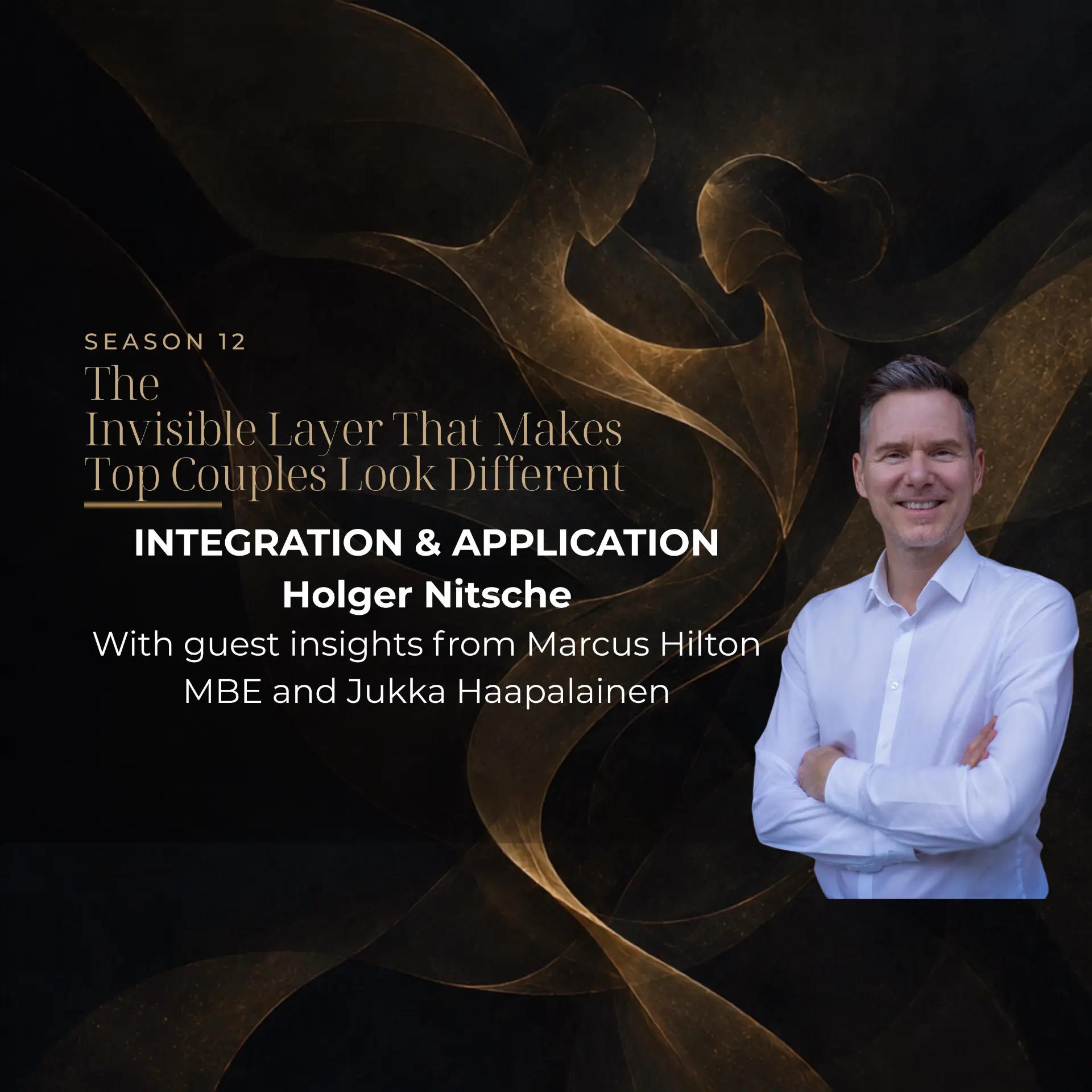
What truly separates a top-class ballroom couple from every other accomplished couple? At the highest level, technical competence, discipline, musical understanding, and extensive training are expected. Yet these qualities alone do not fully explain why certain couples become unmistakable, or why some leave a legacy that continues long after their competitive careers have ended.
This question formed the foundation of the third and concluding MasterClass in our series, led by Holger Nitsche.
What made this session particularly special was the presence of Marcus Hilton MBE, who led the first MasterClass in the series, and Jukka Haapalainen, World Champion and the husband and lifelong dance partner of Sirpa Suutari, who led the second.
For the first time, the perspectives connected to all three MasterClasses came together in one conversation. Holger could draw upon the ideas introduced by Marcus and Sirpa, add his own interpretation, and explore them further with Marcus, Jukka, Jean Dorff, and the participating members.
Beyond Technique
Holger described greatness as a series of interconnected layers.
The first is passion: the inner fire that makes dancers willing to devote themselves fully to their development. But passion alone is not enough. It must be supported by discipline, clear goals, thoughtful training, and sufficient recovery.
Discipline is what converts enthusiasm into lasting progress.
At the same time, the finest couples develop something that cannot be created through effort alone: a recognizable identity. Holger referred to this as a couple’s own “handwriting”—a distinctive artistic signature expressed through movement, musicality, emotional character, and partnership.
This identity cannot be assembled by copying successful dancers or collecting disconnected ideas from different teachers. Influences must be studied, tested, and eventually absorbed until they become part of the couple’s own understanding.
Jukka’s reflection on learning to break the rules was especially relevant. Artistic freedom becomes meaningful only after the underlying principles have been understood. Without knowledge, individuality can become mannerism; without individuality, knowledge can become imitation.
Jean’s reference to becoming a “strand of the medium” added another dimension. A couple does not become distinctive by separating itself from ballroom dancing, but by contributing something recognizable to its continuing development.
Partnership as a Third Personality
One of the strongest ideas to emerge was that a partnership eventually becomes more than two individual dancers.
Over time, the couple develops a third personality, something that belongs neither entirely to one partner nor the other, but exists between them.
This shared personality can be seen in timing, responsiveness, trust, and the ability to make complex coordination appear effortless. The audience sees unity, but not the years of adjustment, communication, and shared experience required to create it.
The deepest excellence is often unflashy. It does not call attention to its complexity because that complexity has become fully integrated.
Doubt, Confidence, and Presence
Marcus offered an important reflection on the role of technical doubt. His own doubts did not prevent mastery; they helped drive his search for it.
This challenges the assumption that champions are always certain of themselves. Their distinction may lie not in having fewer doubts, but in learning how to turn doubt into disciplined inquiry.
Competitive greatness also requires presence. A couple must be seen, felt, and remembered.
Presence is not reserved for naturally extroverted dancers. Confidence, projection, and emotional availability can all be developed. The goal is not to manufacture a larger personality, but to remove the hesitation that prevents a couple’s real personality from reaching the audience.
What Made This MasterClass Different
This was more than the final lecture in a three-part series.
Marcus could revisit the ideas from his first MasterClass in response to Holger’s synthesis. Jukka brought another dimension to the partnership represented in Sirpa’s MasterClass. Holger connected both earlier perspectives with the insights developed during the Group Coaching sessions and his own experience as a dancer, teacher, and coach.
The result was a genuine exchange between champions rather than a single prescribed formula for success.
Their pathways were different, but several common principles remained: passion supported by discipline, technical understanding transformed into individuality, and two dancers developing into one recognizable partnership.
Perhaps this is the invisible layer we were searching for.
Greatness is not found in one exceptional quality. It emerges when many qualities—technical, artistic, physical, emotional, and relational—begin to work together so completely that the audience no longer sees the effort behind them.
They simply see the couple.
This article draws on the masterclass by Holger Nitsche, World Champion, author, lecturer, and internationally recognized dance educator, and founder of masterclasses.dance, taught for the series he created. Alongside co-host Jean Dorff, dance teacher, coach, and author, Holger hosts every masterclass and leads the twice-monthly group coaching at masterclasses.dance, continuous professional development for serious dance educators.
Watch the Full Masterclass